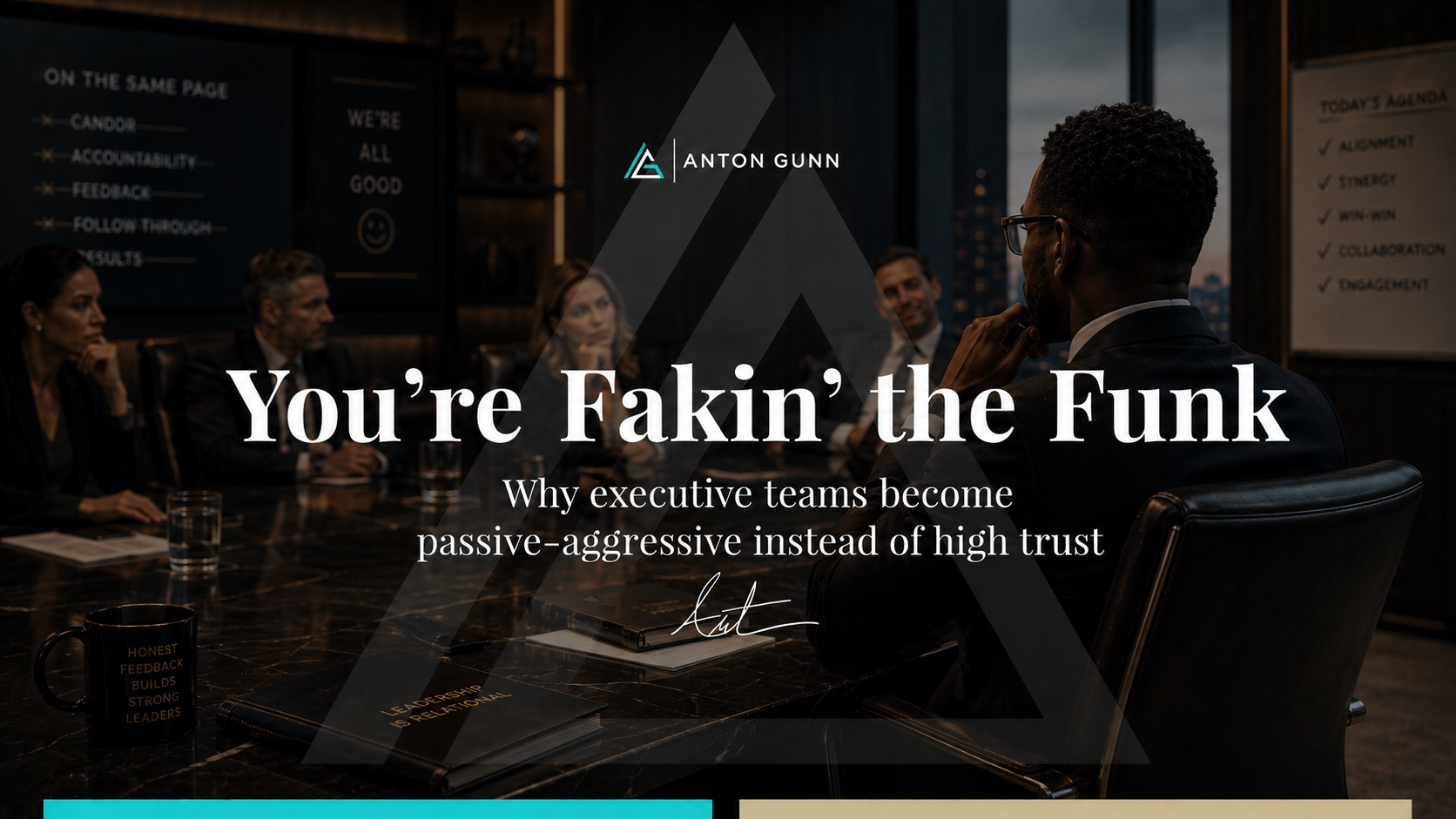
Why executive teams become passive-aggressive instead of high trust
One of the clearest signs of dysfunction on an executive team isn’t open conflict.
It’s passive-aggression.
That might surprise you, because most leaders assume no open conflict means the team is healthy. In reality, too much artificial harmony usually means the opposite. People aren’t disagreeing less. They’re just disagreeing sideways.
They talk around each other instead of to each other. They protect their position instead of pursuing clarity. They smile in the meeting and vent the second they’re in the hallway.
That is not high trust. That is managed discomfort wearing a suit.
Passive-aggression takes root when people stop believing candor is safe, or even useful. If direct feedback gets punished, ignored, or spun into office politics, your leaders will reach for softer weapons instead. They’ll withhold information. Delay decisions. Agree with you in the room and resist you everywhere else. They’ll drop side comments that keep the tension alive without ever naming it.
Over time, that behavior eats the team from the inside out.
The most expensive thing in leadership has never been conflict. It’s unresolved conflict dressed up as professionalism.
Healthy executive teams know how to disagree without making it personal. They can challenge an idea without undermining the person behind it. They can say, “I don’t see it that way,” without turning the room into a loyalty test.
That takes maturity.
It also takes trust. And trust does not grow in a room where people are afraid of how you’re going to react.
A lot of executive teams turn passive-aggressive not because of strategy, but because of emotional safety. Somebody in that room has enough power to make candor cost something. Or somebody has built a pattern where speaking directly always turns into a longer fight. Once that pattern sets in, people stop spending the energy and start avoiding the hard truth instead.
The organization always pays for that avoidance later.
Projects slow down. Decisions get muddy. Teams get mixed signals. And middle managers — the ones with the least power and the most exposure — feel the tension first.
Here’s the irony: people say they want alignment. What they actually need is clarity. Alignment built on silence is fragile. It cracks the first time it gets tested. Alignment built on truth is durable — it can take a hit and keep standing.
If you want a high-trust executive team, stop treating tension like a failure. Start treating unresolved tension like a leadership responsibility.
Ask the harder questions: What isn’t being said in this room? Who is holding back? Where are we just pretending to agree? What issue keeps resurfacing because nobody wants to own it directly?
That’s where the real work starts.
Executive maturity isn’t about never having conflict. It’s about building a team that can handle conflict without sliding into politics, games, or quiet retaliation.
If you want less beef, you need more candor. Less performance. More truth.
The absence of open conflict does not always mean trust. Sometimes it just means people have learned to disagree behind your back.
If your executive team is too polite to be honest with you, it’s too fragile to lead anything well.